


Foreign Investors Are Pulling Money Out of Indian Equities: What Should Investors Do?
With foreign investors selling Indian stocks and market volatility rising, here’s how investors can make informed decisions without reacting to every market headline.
Imagine you have been investing a fixed amount every month through a mutual fund SIP. Your investments have been building gradually, and you have a long-term financial goal in mind—perhaps buying a house, funding your child’s education or building a retirement corpus.
Then, one morning, you read the news: foreign investors are pulling thousands of crores out of the Indian stock market. Market indices are falling, financial experts are discussing global uncertainty, and your portfolio value starts declining.
The immediate question is natural: Should I stop my SIP, sell my investments or wait for the market to recover?
Before making a decision, it is important to understand what is driving the news—and what it actually means for your money.
What Is Happening in the Indian Stock Market?
Foreign portfolio investors (FPIs) have been selling Indian equities amid global and domestic economic concerns.
According to a Moneycontrol report published on 9 October 2026, foreign investors withdrew approximately ₹37,929 crore from Indian equities during the first five trading sessions of October. Domestic institutional investors, meanwhile, purchased equities worth ₹35,613 crore over the same period, helping absorb some of the selling pressure. Source: Moneycontrol.
The selling follows substantial foreign outflows in September and comes amid concerns about elevated US bond yields, rising crude oil prices, inflation and a weaker rupee. These factors have contributed to uncertainty in financial markets. Source: Mint.
But what exactly are foreign investors responding to? And why should someone investing through a mutual fund or SIP pay attention?
Let’s break it down.
1. Why Are Foreign Investors Selling Indian Stocks?
Foreign investors allocate money across countries and asset classes based on factors such as expected returns, valuations, interest rates, currency movements and risk.
When these factors change, they may reduce their exposure to one market and move money elsewhere.
Several developments can influence their decisions.
Rising US bond yields
When US Treasury yields rise, US government bonds may become more attractive to global investors relative to certain riskier assets. This can influence how international funds allocate their money between developed and emerging markets.
It does not mean every investor will sell Indian stocks, but it can make it more difficult for emerging markets to attract foreign capital.
Higher crude oil prices
India imports a substantial amount of its crude oil requirements. A sustained increase in oil prices can raise import costs, put pressure on inflation and affect the margins of businesses that depend on energy or transportation.
These concerns can influence expectations about corporate earnings and the broader economy.
Currency movements
When the rupee weakens against the US dollar, returns earned by a foreign investor in Indian equities can be reduced when converted back into dollars, assuming other factors remain unchanged.
This is one reason currency movements can influence international investment decisions.
Global uncertainty
Geopolitical tensions, changing interest-rate expectations and concerns about inflation can make investors more cautious. During uncertain periods, global funds may reassess how much risk they want to take.
The important point: Foreign selling reflects a combination of factors. It should not be interpreted as proof that Indian companies have lost their long-term growth potential or that the market will continue falling.
2. How Do Foreign Investor Outflows Affect the Indian Market?
Foreign portfolio investors are significant participants in Indian equity markets. When they sell large quantities of shares, the additional selling pressure can contribute to price declines, particularly when market sentiment is already weak.
However, foreign investors are not the only participants in the market.
Domestic institutional investors—including mutual funds, insurance companies and other institutions—also invest in Indian equities. Retail investors participate directly and indirectly, including through mutual fund SIPs.
During the opening sessions of October, domestic institutional buying helped absorb part of the foreign selling, although it was not enough to prevent the market from declining. Source: Moneycontrol.
For individual investors, this highlights an important distinction: market prices are influenced by the combined actions and expectations of many participants—not by foreign investor activity alone.
Corporate earnings, valuations, economic growth, interest rates and domestic investment flows also matter.
Foreign outflows are therefore an important market signal, but they should not be treated as a standalone prediction of future returns.
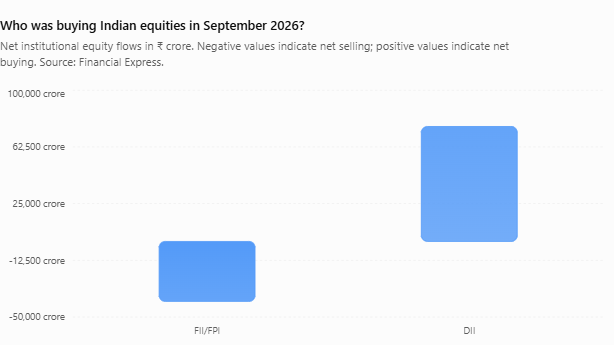
Source: Financial Express. Figures are rounded.
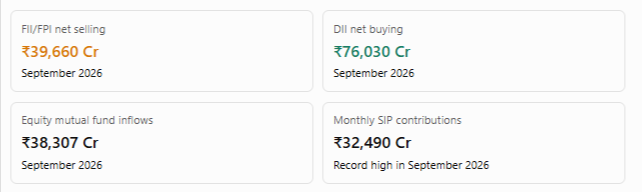
Sources: Financial Express — institutional flows and Financial Express — mutual fund and SIP data
3. Should You Stop Your SIP When Foreign Investors Are Selling?
For investors who see their portfolio value decline, stopping a SIP can feel like a way to avoid further losses.
But the right decision depends on your financial goals, investment horizon, risk tolerance and financial circumstances.
A systematic investment plan (SIP) allows you to invest a predetermined amount at regular intervals in a mutual fund. When the market falls, the same investment amount may purchase more units than it would at a higher price. When markets rise, it may purchase fewer units.
This is known as rupee-cost averaging. It can help spread investments across different market levels, but it does not guarantee profits or protect your portfolio from losses.
Before stopping or changing your SIP, ask yourself three questions:
Is the money meant for a long-term goal?
If you are investing for a goal many years away, short-term market movements may not, by themselves, justify changing your plan. Your investment choice should still match your ability to tolerate losses.
Has your financial situation changed?
A job change, an unexpected expense, a new financial responsibility or a reduced emergency fund may justify reviewing how much you invest every month.
Does your portfolio still match your risk tolerance?
If market declines are causing significant stress, your portfolio may contain more risk than you are comfortable taking. A review of your asset allocation may be more useful than reacting to a single news headline.
The lesson is not to continue every SIP regardless of circumstances. It is to make changes based on your financial plan rather than fear alone.
4. Is This the Right Time to Invest More in the Market?
When markets fall, investors often hear two conflicting messages: “Buy the dip” and “Stay away until things improve.”
Neither is a universal solution.
A lower market price does not automatically mean every stock or fund is attractively valued. Similarly, waiting for the market to feel completely safe can mean missing opportunities when conditions improve.
Instead of trying to predict the market’s bottom, consider the following:
- Review your time horizon. Money required soon may not be suitable for volatile equity investments.
- Assess your emergency fund. Keep sufficient liquid savings for essential expenses and unexpected needs.
- Check your asset allocation. Make sure your exposure to equity, debt and other investments aligns with your goals and risk profile.
- Avoid concentrated bets. Do not invest a large portion of your savings in a single stock, sector or investment theme simply because prices have fallen.
- Invest according to a plan. If you are considering additional investments, assess whether the amount and timing suit your financial circumstances.
For some investors, maintaining an existing long-term plan may be appropriate. Others may need to reduce risk or postpone additional investments.
The decision should be based on the investor’s circumstances—not a market headline alone.
5. Why Portfolio Diversification Matters During Market Volatility
Diversification means spreading investments across different assets, sectors or investment categories instead of depending too heavily on one source of returns.
For example, an investor whose entire portfolio is concentrated in equities may experience a significant decline when stock markets fall. A portfolio that also includes suitable fixed-income investments and liquid reserves may behave differently, depending on its composition and market conditions.
Diversification does not eliminate risk. Different asset classes can decline at the same time, and some investments may be difficult to sell quickly without a loss.
Nevertheless, a thoughtfully constructed portfolio can help manage concentration risk and align investments with different financial goals.
Consider reviewing the following:
Equity investments: Are your investments spread across suitable companies, sectors and fund categories, or are you heavily exposed to a narrow segment of the market?
Fixed-income investments: Do suitable debt instruments or other fixed-income options have a role in meeting your stability and income requirements?
Liquidity: Do you have money available for near-term expenses without being forced to sell long-term investments during a market downturn?
Time horizon: Are your investments aligned with when you expect to need the money?
A portfolio review should consider all these factors together rather than focus only on recent returns.
6. What Should Investors Watch in the Coming Weeks?
Instead of trying to interpret every daily market movement, investors can follow a few important indicators.
Foreign and domestic investment flows
Monitor FPI and domestic institutional investor activity to understand how different investor groups are positioning themselves. These flows can influence sentiment, but they do not reliably predict market direction on their own.
US Treasury yields and the dollar
Changes in US bond yields and the dollar can influence global capital allocation and currency movements. Their impact on Indian markets will also depend on domestic conditions.
Crude oil prices and inflation
Sustained increases in crude oil prices can affect India’s import bill, inflation outlook and business costs. These developments can influence expectations for interest rates and corporate profitability.
Corporate earnings and valuations
Ultimately, the long-term value of an equity investment depends on several factors, including a company’s financial performance, future prospects and the price investors pay for it.
A fall in the market should therefore prompt investors to look beyond index movements and consider the underlying fundamentals of their investments.
7. A Practical Checklist: What Should You Do With Your Portfolio?
If recent market volatility has made you reconsider your investments, start with this checklist.
- Revisit your goals: Identify which investments are intended for short-, medium- and long-term needs.
- Check your risk tolerance: Consider whether you can financially and emotionally manage further declines.
- Review your asset allocation: Assess whether your current mix of investments remains appropriate.
- Evaluate your SIPs: Check whether your contributions remain affordable and aligned with your goals.
- Maintain adequate liquidity: Avoid depending on equity investments for expenses that are approaching soon.
- Review concentration risk: Check whether your portfolio is overly dependent on a single stock, sector or asset class.
- Avoid impulsive decisions: Do not buy or sell solely because foreign investors are entering or leaving the market.
- Seek professional guidance when needed: If your portfolio is complex or your goals have changed, consider a qualified financial professional.
The objective is not to ignore market developments. It is to put those developments into the context of your personal financial plan.
How BiggPocket Can Help You Make More Informed Wealth Decisions
Market uncertainty is a reminder that investing should begin with a clear understanding of your financial goals—not with the latest market trend.
At BiggPocket, wealth planning is about helping investors explore suitable financial solutions in line with their objectives, time horizons and risk considerations.
Depending on your needs and eligibility, this may involve exploring mutual funds and SIPs, fixed-income options or other wealth-management solutions.
The aim is to help you assess your options, understand the associated risks and make decisions with a longer-term perspective.
Rather than asking only, “What is the market doing today?”, it is worth asking a more useful question: “Is my financial plan prepared for different market conditions?”
Final Thoughts: Don’t Let Market Headlines Decide Your Financial Future
Foreign investors have been withdrawing substantial amounts from Indian equities, and global economic pressures have contributed to market volatility. These developments deserve attention—but they do not tell the whole story.
Markets can respond to changing expectations, and foreign investment flows can reverse as conditions evolve. Neither outcome is guaranteed.
For individual investors, the more durable approach is to understand their goals, maintain suitable diversification, manage liquidity and review risk regularly.
The goal is not to predict every market move. It is to build a financial strategy that can withstand uncertainty while keeping your long-term goals in focus.
Ready to review your wealth strategy?
Explore wealth-management solutions with BiggPocket and take a more informed approach to your financial goals.
Badho, Befikar.
Disclaimer: This article is for general informational and educational purposes only and does not constitute investment advice or a recommendation to buy or sell any security or financial product. Investments in securities and mutual funds are subject to market risks. Past performance and market indicators do not guarantee future returns. Investors should assess their financial goals, risk tolerance and investment horizon before making decisions.
Repo Rate Up: What the RBI’s Move Means for Your Business
Picture two business owners on the morning of 7 October.
Rohan is 24. He runs a D2C brand from a rented flat in Gurugram, and his growth is funded by a working-capital line and a lot of UPI receipts. Mr. Mehra is 52. He has run a packaging unit for three decades, with a machinery loan and a ledger he trusts more than any app.
Different generations, different worlds. Both woke up to the same headline: the RBI has raised the repo rate.
So, what actually happened?
The RBI’s Monetary Policy Committee voted unanimously to raise the repo rate by 25 basis points, from 5.25% to 5.50%, its first hike since February 2023. The stance also shifted to “calibrated tightening” to deal with persistent inflation.
This is not a panic button. The RBI also raised its FY27 growth forecast to 7.1%, so the hike is a response to inflation, not to economic weakness. Think of it as the central bank tapping the brakes on a car that is still moving fast.
The repo rate in one line
It is the rate at which the RBI lends to banks. When it rises, money gets more expensive for banks, and they may pass some of that cost on to you.
The key word is may. Your loan is not automatically costlier tomorrow. It depends on how your loan is built.
Where you’ll feel it
1. Your existing loans. This is the first thing to check, and it is where the two generations differ most. If your loan is floating and linked to an external benchmark, it can become costlier when the lender resets the rate, while a fixed-rate loan does not automatically change. Mr. Mehra may see a higher EMI or a longer tenure. Rohan, if his line is repo-linked, may see his interest cost creep up. Either way, the answer is in your loan agreement, not in the news.
2. Working capital. This is the quiet one. Say you pay suppliers today but your customers pay in 45 days. That gap runs on borrowed money, and when borrowing gets pricier, the gap eats into your margin. Small increases add up for anyone who lives on an overdraft. The cheapest fix is often operational: chase receivables faster and don’t over-stock.
3. Expansion plans. Don’t cancel them, but stress-test them. A new machine or warehouse can still make sense if the extra cash flow comfortably covers the EMI, even in a slow month. Waiting too long can also cost you an opportunity. The question to ask is whether the returns justify the borrowing, not whether you can get the loan.
Your five-minute action list
- Pull out your loan documents. Is the rate fixed or floating, and when is the next reset?
- Run a “what if” calculation. How much more would you pay if your rate rose by 0.25% or 0.5%?
- Look at the full cost of any new loan, including processing fees, collateral and repayment terms, not just the headline rate.
- Keep a cash buffer. Don’t put every rupee into growth.
That last point matters because the story may not be over. Some economists suggest the repo rate could rise further, to 5.75–6%, if inflation stays high. The next MPC meeting is scheduled for 2 to 4 December 2026.
The bottom line
Rohan and Mr. Mehra are in the same position. Whether you are starting out or carrying a business built over decades, the lesson is the same: borrow with a plan, not on impulse.
Rate hikes come and go. A business that knows its numbers, watches its cash flow and compares its options carefully will manage them well. Panic is optional, and preparation is not.
Disclaimer: This article is for general information only and is not financial advice. Loan terms and rates vary by lender and agreement.